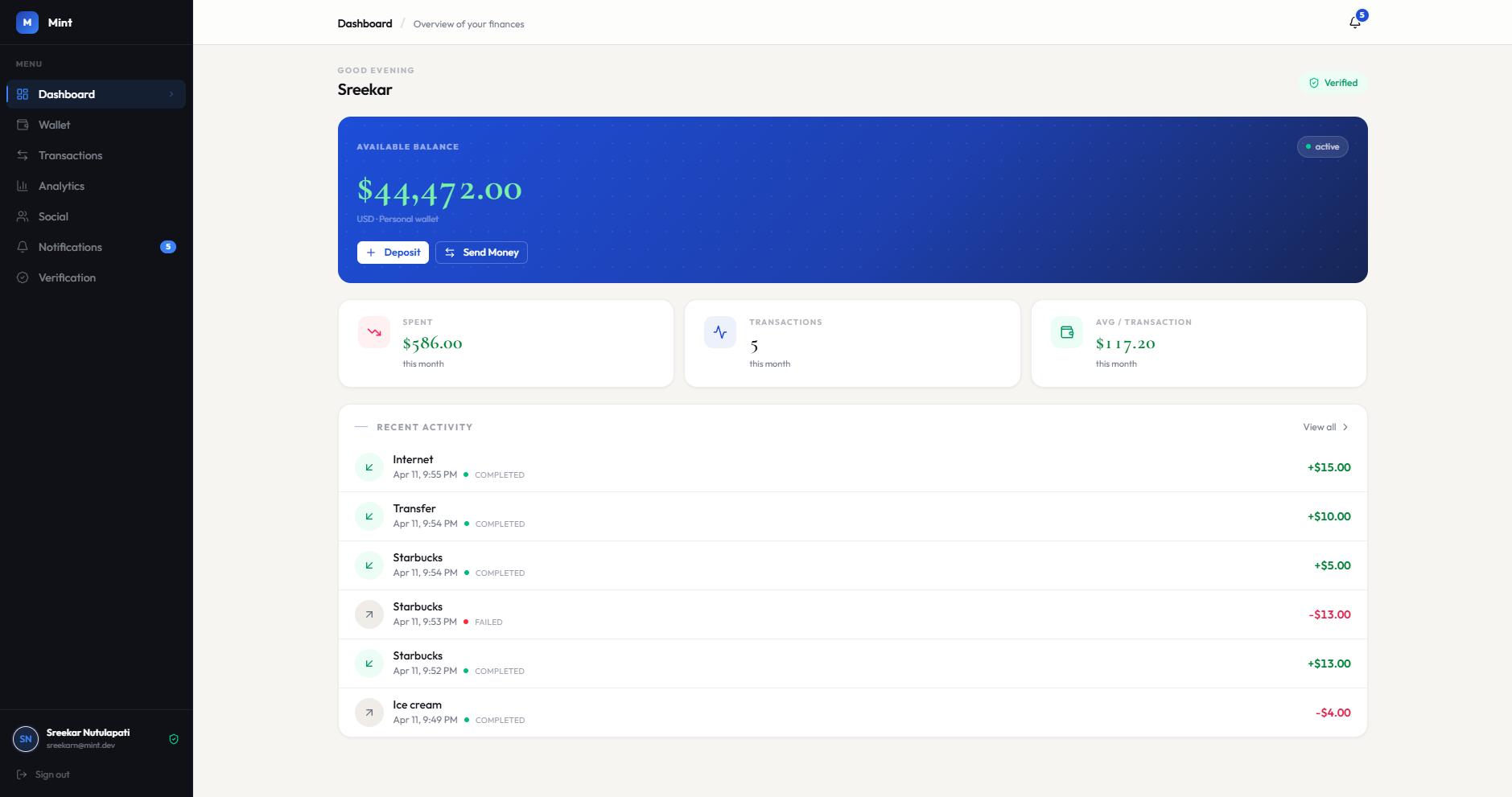
Mint is a full-stack fintech platform built across 12 independently deployable services. It covers the full lifecycle of a digital wallet - from identity verification and fraud scoring to social payments, budget analytics, and a tamper-proof audit log - all wired together through synchronous gRPC and asynchronous Kafka.
Overview
The platform is polyglot by design: auth and wallet are FastAPI (Python), everything else is NestJS (TypeScript), and the frontend is Next.js 15. Services communicate synchronously over gRPC when a result is needed before proceeding (fraud scoring, KYC limit checks, wallet settlement), and asynchronously over Kafka for fan-out side effects (notifications, analytics, audit logging, webhooks). Every service has its own isolated PostgreSQL database.
Key Features
Authentication & Identity
- JWT (RS256) with JWKS - Auth service signs tokens with an RSA private key; all other services verify locally against the public JWKS endpoint, no round-trips required
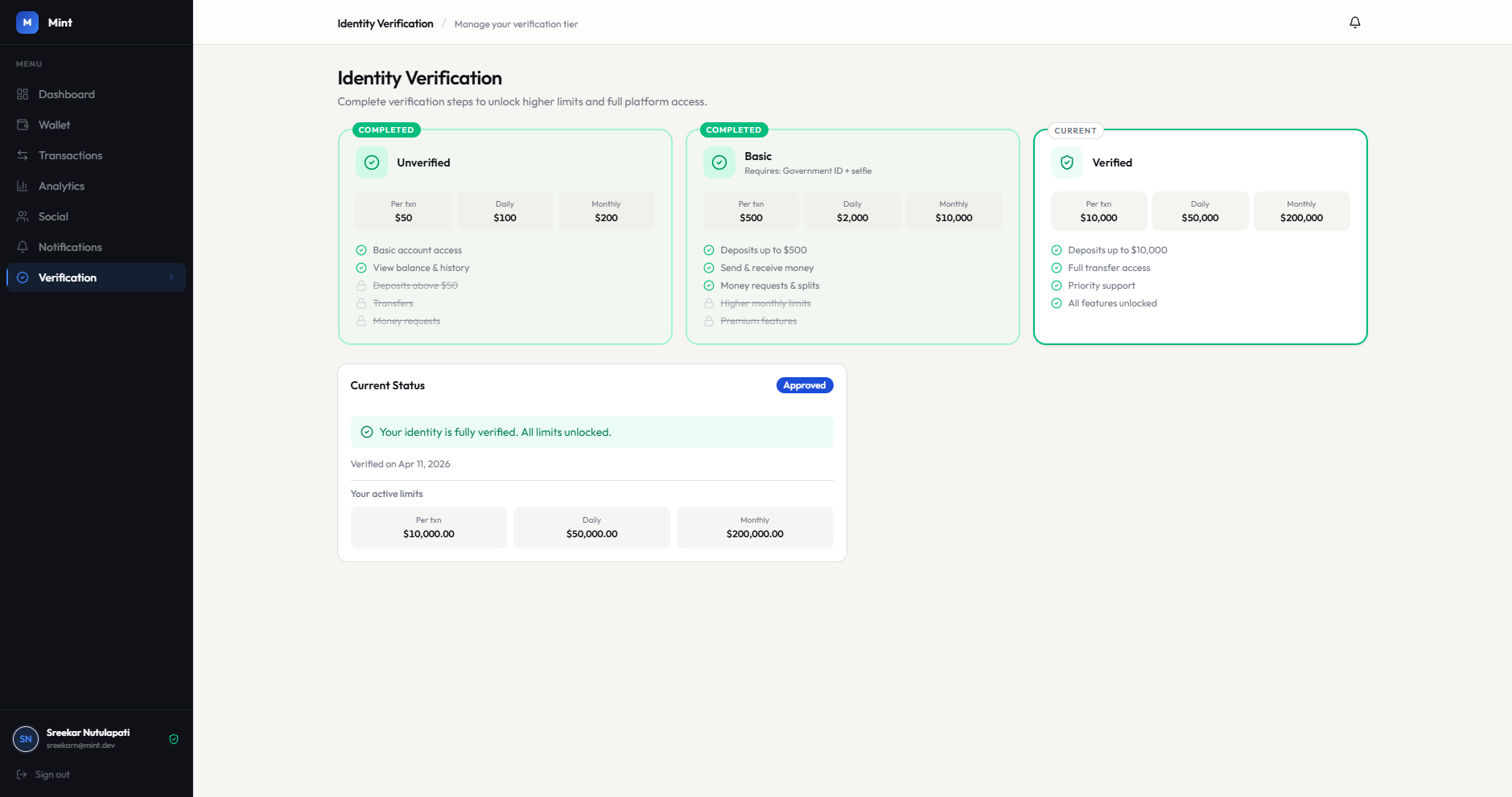
- KYC Tiers - Users progress through UNVERIFIED -> BASIC -> VERIFIED; each tier unlocks higher per-transaction and monthly spend limits
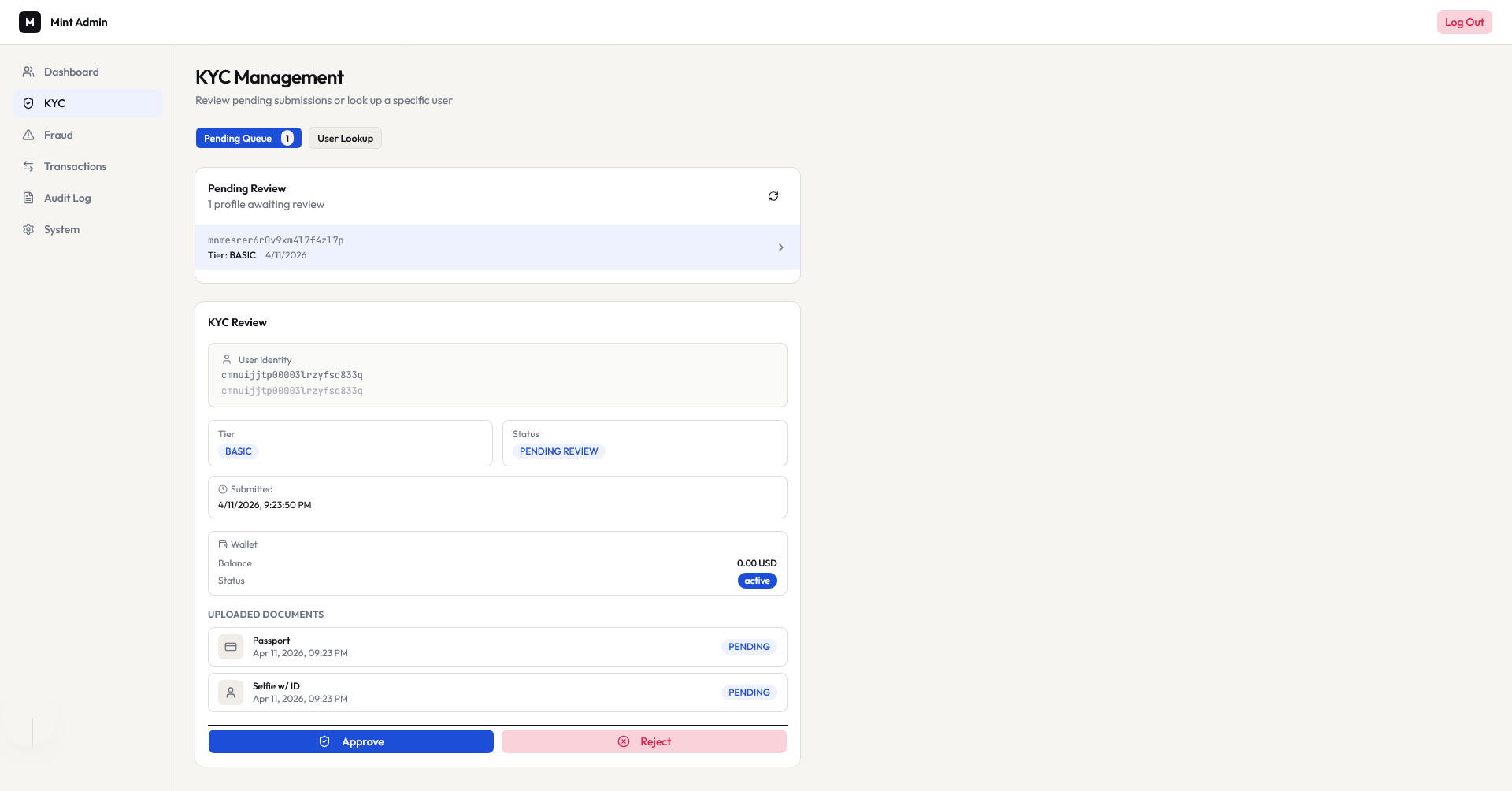
- Document Upload - KYC submissions are stored in MinIO (S3-compatible); admins review and approve/reject via a dedicated queue
- Admin Role - Separate JWT claim gates the admin console; admin service enforces it on every request
Transaction Engine
- Fraud Scoring - Every transaction calls the fraud service via gRPC before settlement. Returns ALLOW / REVIEW / BLOCK with a 0-100 score and the rules that fired
- KYC Limit Enforcement - Transactions service calls KYC service via gRPC to check per-transaction and daily/monthly limits before debiting
- Atomic Settlement - Wallet debit and credit happen over gRPC; both must succeed or the transaction fails
- State Machine - PENDING -> PROCESSING -> COMPLETED / FAILED / CANCELLED / REVERSED
- Idempotency -
Idempotency-Keyheader; responses cached in Redis for 24 hours so retries are safe
Social Payments
- Money Requests - Request funds from contacts with a 7-day expiry (BullMQ scheduled job). Accepting a request automatically triggers a transfer via Kafka -> transactions service
- Bill Splits - Create a split, assign per-participant amounts, track individual payments
- Contacts - Managed contact list scoped per user
Analytics & Budgets
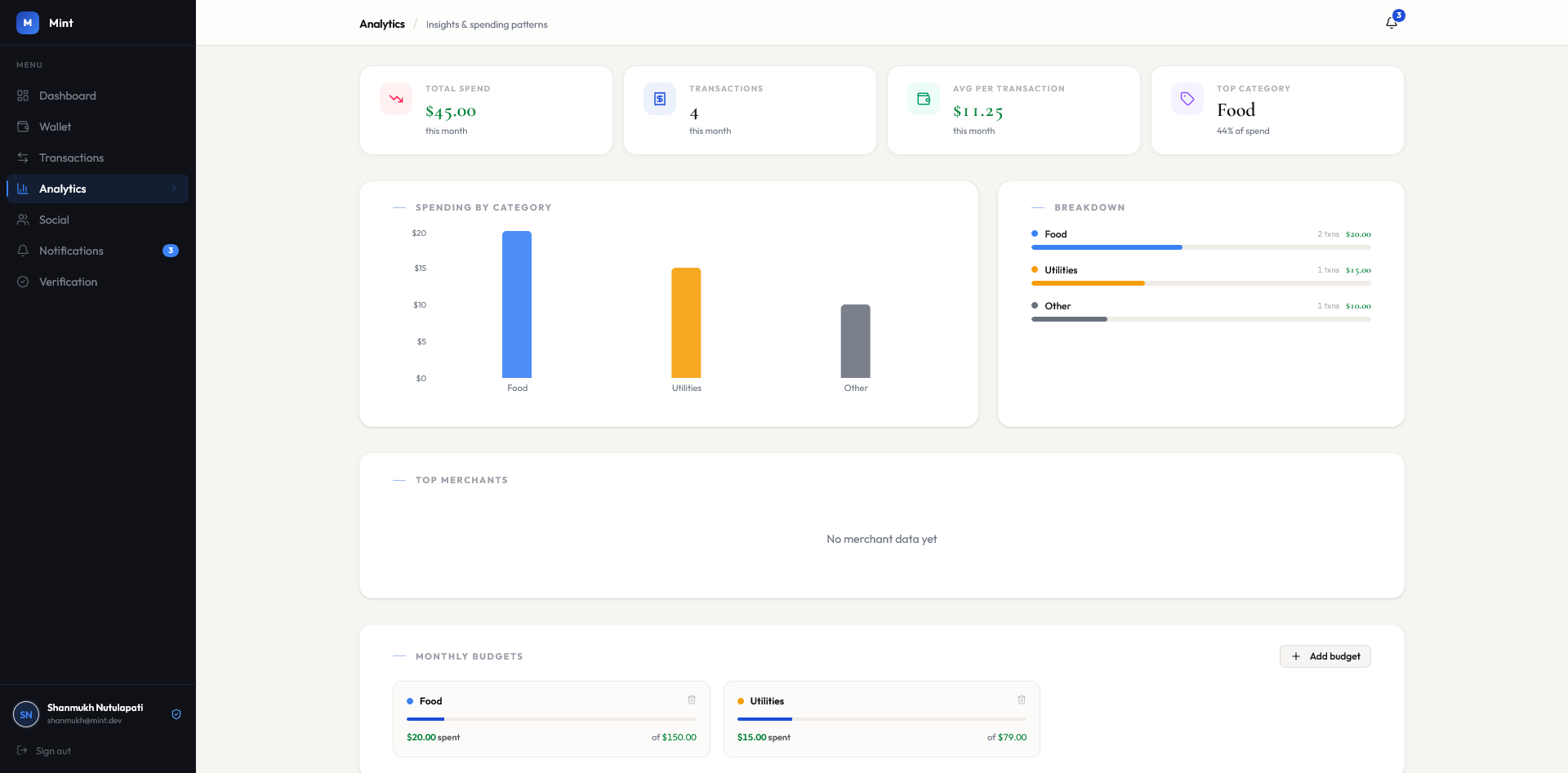
- Spend Categorisation - Completed transactions are auto-classified into FOOD, TRANSPORT, ENTERTAINMENT, UTILITIES, OTHER by merchant name and description matching
- Monthly Aggregates - Category totals and top merchants updated in real-time from Kafka events
- Budget Alerts - Users set per-category budgets; the analytics service publishes a Kafka event when a threshold is crossed, triggering a notification
Notifications & Webhooks
- Real-Time SSE - In-app notification stream over Server-Sent Events; nginx disables proxy buffering so events land immediately
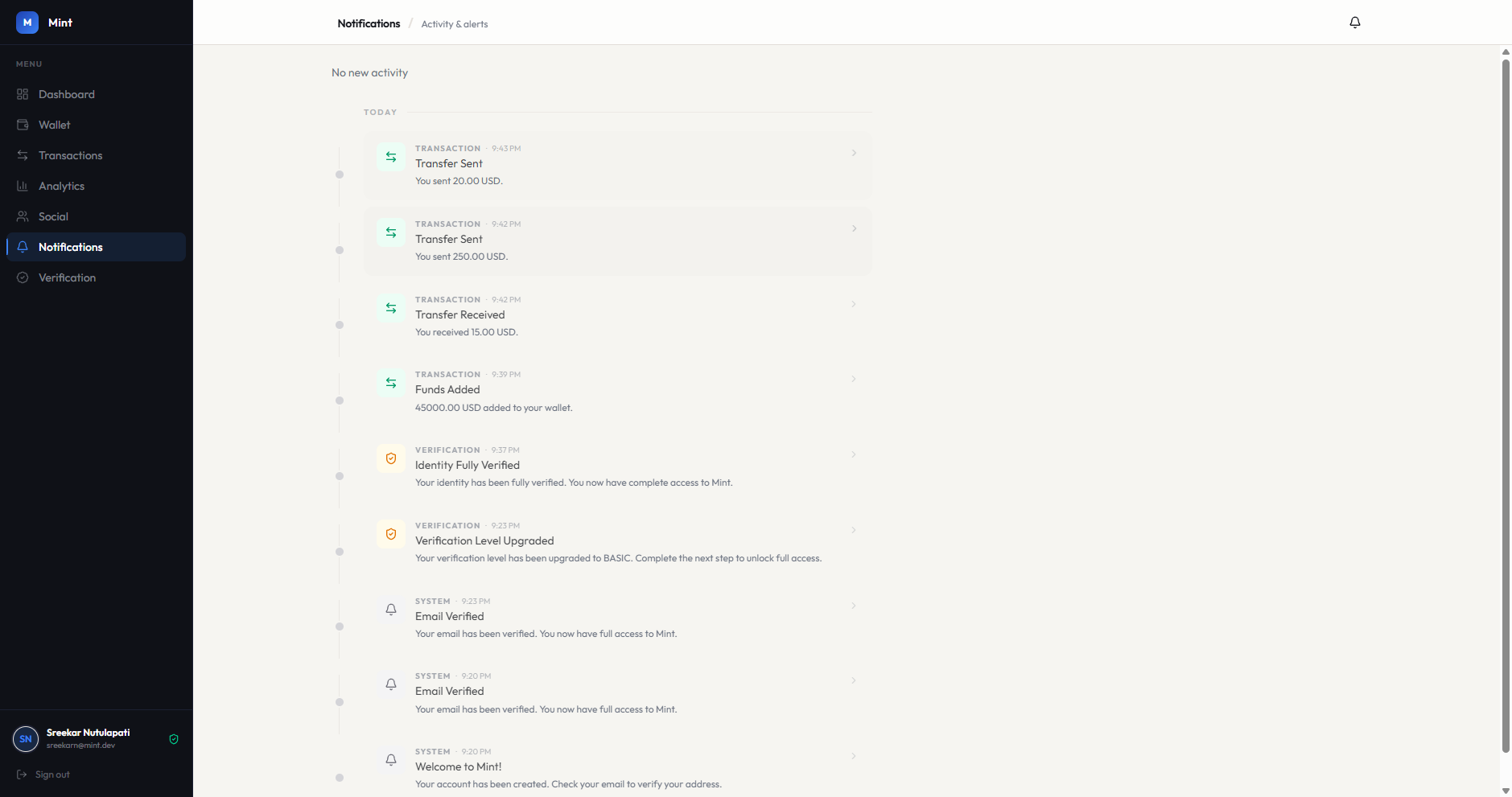
- Persistent Feed - Notifications stored in DB, readable as a paginated list with read/unread state
- User Webhooks - Users register HTTPS endpoints and subscribe to event types; payloads are HMAC-signed, delivered with exponential backoff retry via BullMQ
Admin Console
- User Management - Search, freeze/unfreeze accounts, update roles
- KYC Review Queue - Inspect submitted documents, approve or reject (emits Kafka event -> KYC service updates tier)
- Fraud Review Queue - Review REVIEW-scored transactions, approve or block
- Transaction Operations - List, reverse, or force-complete stuck transactions
- Global Limits - Configure platform-wide transaction limits without a deployment
Audit Log
- Immutable by Design - PostgreSQL trigger prevents UPDATE and DELETE on the audit table; every service publishes to
audit.events - Full Traceability - Each entry preserves the OpenTelemetry trace ID so any log entry can be correlated back to the original distributed trace in Grafana
Observability
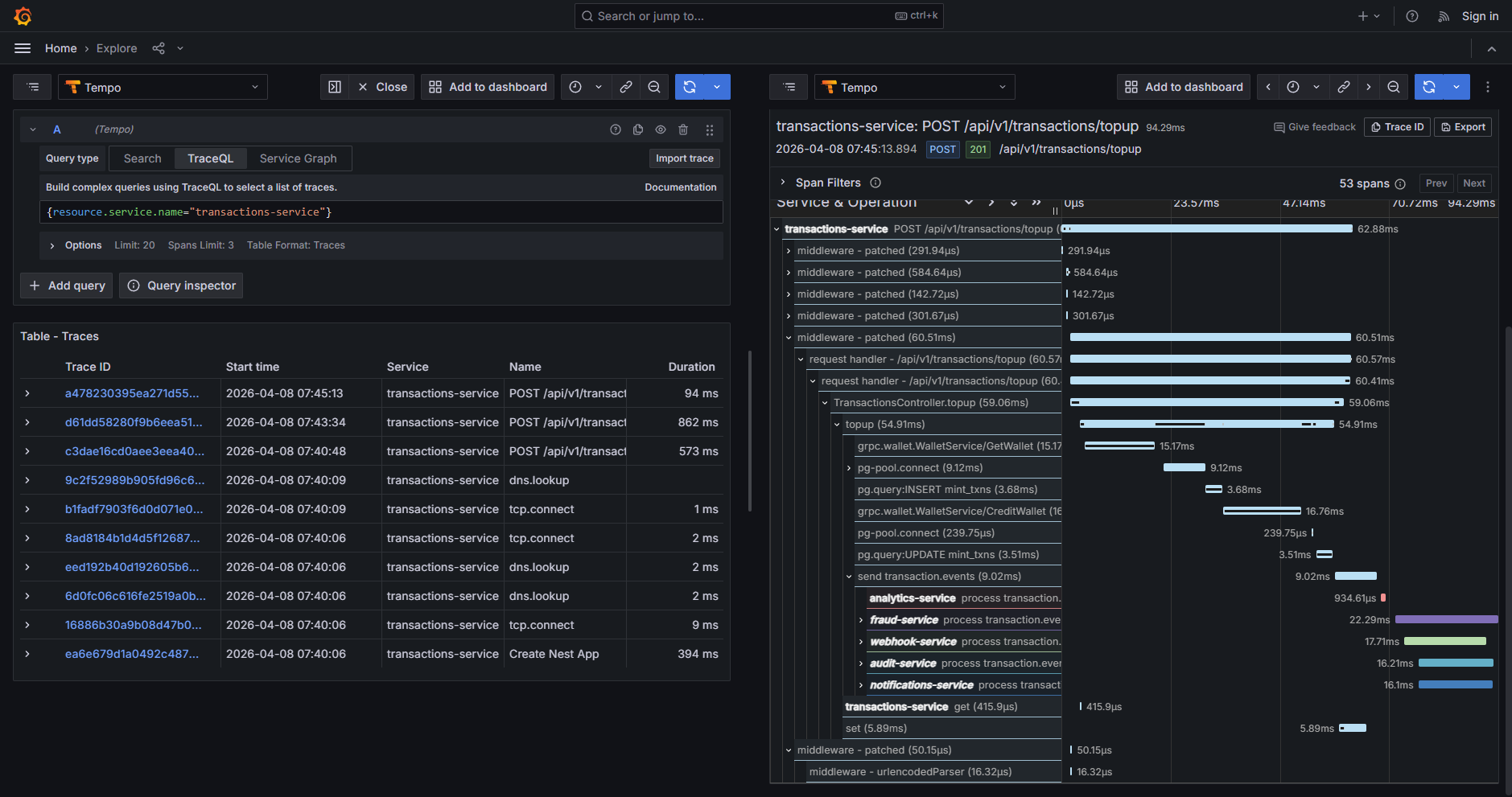
- Distributed Tracing - Every service ships OTLP traces to a local collector -> Grafana Tempo. A single top-up produces one trace spanning fraud scoring, KYC checks, wallet settlement, and all Kafka consumers
- Trace Propagation - W3C Trace Context over HTTP, gRPC metadata for gRPC calls, custom
KafkaTraceInterceptorwrites/reads trace headers on Kafka messages so async boundaries don’t break the trace
Architecture
The platform is fronted by a single NGINX reverse proxy that routes HTTP traffic to the Next.js web app and to each of the API services. The transactions service and the admin service also reach the fraud, KYC, and wallet services over gRPC for synchronous lookups before settling a payment or rendering an admin view.
Communication Patterns
Mint uses two distinct internal communication patterns depending on whether the caller needs a synchronous result.
Synchronous - gRPC is used when the caller must have a result before continuing:
| Caller | Target | Purpose |
|---|---|---|
| transactions | fraud | Score every transaction before settlement |
| transactions | kyc | Check per-transaction and daily/monthly limits |
| transactions | wallet | Debit sender, credit recipient atomically |
| admin | kyc | Fetch KYC profiles and pending review queue |
| admin | wallet | Fetch wallet status for user management |
| admin | fraud | Fetch and action fraud cases |
Asynchronous - Kafka is used for fan-out side effects where the producer doesn’t need to wait:
| Topic | Key Consumers |
|---|---|
auth.events | wallet (create), kyc (create profile), notifications, audit |
transaction.events | analytics, notifications, webhook, audit |
wallet.events | notifications, webhook, audit |
kyc.events | notifications, audit |
social.events | transactions (auto-transfer on accept), notifications, audit |
analytics.events | notifications (budget alerts), webhook |
admin.events | kyc (approve/reject tier), audit |
Services
| Service | Stack | Port | Description |
|---|---|---|---|
| web | Next.js 15 | 3000 | User app and admin console |
| auth | FastAPI | 4001 | JWT issuance, refresh, RBAC |
| wallet | FastAPI + gRPC | 4002 / 50051 | Balance management, atomic settlement |
| transactions | NestJS | 4003 | Transfers, top-ups, idempotency |
| fraud | NestJS (gRPC only) | 50052 | Real-time rules-based fraud scoring |
| kyc | NestJS + gRPC | 4004 / 50053 | Document upload, tier management |
| analytics | NestJS | 4005 | Spend insights, category budgets |
| notifications | NestJS | 4006 | Persistent notifications + SSE stream |
| social | NestJS | 4007 | Contacts, money requests, bill splits |
| webhook | NestJS | 4008 | User-registered webhooks + delivery log |
| admin | NestJS | 4009 | Admin console API |
| audit | NestJS | 4010 | Immutable append-only audit log |
Getting Started
# Clone the repository
git clone https://github.com/sreekarnv/mint.git
cd mint

# Generate RSA keys (first time only)
sh scripts/generate-keys.sh

# Start all services
docker compose -f docker-compose.dev.yml up -d --build

# Create an admin user
docker exec -it mint-auth uv run python /app/apps/auth/src/create_admin.py \
  --email admin@mint.dev \
  --password adminpass \
  --name "Admin User"
The user app is at http://localhost and the admin console at http://localhost/app-admin. Grafana traces are at http://localhost:4000.
What I Learned
Building Mint at this scale forced me to confront the real costs of distributed systems:
- Two communication protocols serve different needs - gRPC for synchronous calls where you need a result (fraud scoring, limit checks, settlement) and Kafka for async fan-out where you don’t. Conflating them leads to either tight coupling or unnecessary latency
- Polyglot is genuinely useful, but the integration surface is the hard part - Python services handle the stateful, mutation-heavy wallet and auth work well, but wiring gRPC stubs, shared proto definitions, and trace propagation across runtimes requires discipline
- Observability must be designed in, not bolted on - Getting a single trace to span HTTP -> gRPC -> Kafka required explicit propagation at every boundary. Without it, async failures are nearly impossible to debug in production
- Idempotency is not optional in financial systems - Network retries are guaranteed to happen; building safe retry handling from the start saved considerable pain later
- The audit log is the source of truth - Having an immutable, append-only log that every service writes to independently made debugging event ordering issues far easier than reading application logs